How to organise an online gaming tournament
Most guides tell you what a tournament is. This is the list of decisions you have to make before twenty strangers join your lobby, in the order you have to make them.
The Fragnet team · Published 17 August 2026 · 11 min read
How we know this: Every mechanism described here — approval queues, entry passes, timed room reveal, no-show tracking — is something Fragnet implements, so the descriptions are of working behaviour rather than theory. Where a step needs no platform at all, this says so.
Fragnet lists events. We don’t vet organizers, we never hold entry fees or prize money, and we have no brackets, results entry or leaderboards. Anything in this article about running an event assumes you own those parts.
Decide these four things before you publish anything
Almost every tournament that falls apart does so because one of these was left undecided until it mattered. None of them take more than a minute once you know they are the questions.
1. How many slots, exactly
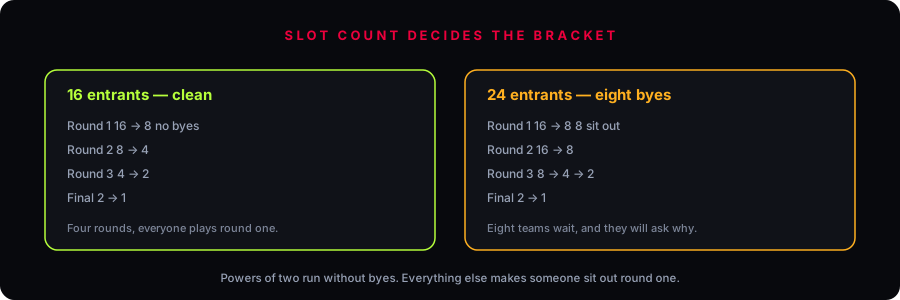
Pick a number that fits your bracket, not a number that sounds good. Sixteen and thirty-two run clean single elimination with no byes. Twenty-four does not — you will have eight teams sitting out round one, and they will ask why.
For battle royale the constraint is different: the lobby size is set by the game. Ninety-nine players or twenty-five squads in PUBG and BGMI, forty-eight in Free Fire. Publishing more slots than the lobby holds is the single most common mistake in mobile events.
2. Whether you approve entries or take all comers
Approval means you read every request and decide. It is slower and it is what you want for anything with an entry fee or a skill requirement. Instant join fills faster and suits free scrims where nobody minds who turns up.
3. When you hand out the room credentials
This is the one people underestimate. Post the room ID publicly and you get strangers in your lobby. Send it too early and it leaks. Send it manually to twenty people at once and you will still be sending them when the match should have started.
4. What happens when someone does not turn up
Decide the substitution rule before it happens, not during. Written down, it is a rule. Invented on the spot, it is favouritism — and it will be described that way in your Discord afterwards.
Write the listing so people can judge it
Entrants are deciding whether you are real. Amateur events get abandoned often enough that experienced players screen for it, and a thin listing reads as a risk regardless of your intentions.
- Exact start time, with the timezone written out. "8pm" is not a time on the internet.
- The full rules, before anyone joins — not "rules will be shared in Discord".
- What the prize actually is, and when it gets paid. "₹5,000 prize pool" without a payout date is the single biggest trust gap in amateur events.
- Who you are. A name and a track record beat an anonymous poster every time.
- What happens if the event is cancelled and money has changed hands.
The prize question is the one that decides entriesA smaller prize that is clearly described and paid on a stated date will fill faster than a larger one with no detail. Entrants have been burned before, and they read listings accordingly.
On the day
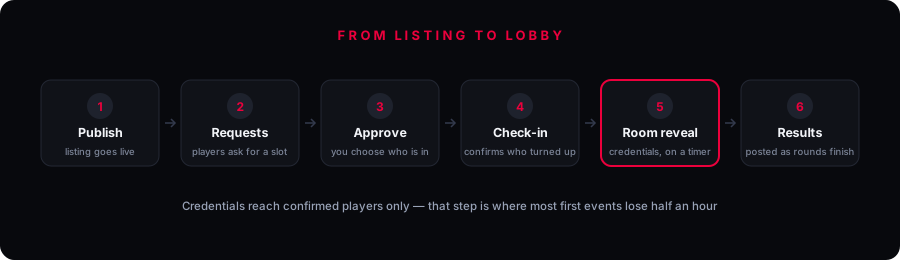
- 1.Open check-in about thirty minutes before start. This is what separates people who are coming from people who registered a week ago and forgot.
- 2.Release room credentials only to confirmed players, as close to the start as you can manage.
- 3.Fill empty slots from your waitlist as check-in closes, not after round one has begun.
- 4.Post results as each round finishes. A bracket nobody can see generates the same three questions on repeat.
- 5.Pay out when you said you would. This is the entirety of your reputation for the next event.
Steps two and three are the ones worth automating if you can. Sending a room ID to twenty confirmed players by hand, at the moment you are also trying to start a match, is where most first events lose half an hour.
What you actually need, and what you do not
You can run a tournament with a spreadsheet and a Discord server. Thousands of people do. It is worth being honest about where that stops working rather than pretending you need software from the start.
| You need | When a spreadsheet stops being enough |
|---|---|
| A public listing people can find | When you want entrants beyond your own server |
| A way to collect and approve entries | Past about twenty, when DMs become the bottleneck |
| Credentials delivered to confirmed players only | The first time a room ID leaks |
| A bracket everyone can see | The first time someone disputes a result |
| A record of who did not turn up | The second event, when the same names reappear |
Fragnet does the middle three. Listing an event is free, we take no cut, and we never hold entry fees or prize money — that is arranged directly between you and your entrants, which is worth stating plainly because several platforms do not.
Common questions
- How many players do I need for a first tournament?
- Sixteen is the sweet spot for bracket games — it runs four clean rounds with no byes and finishes in an evening. For battle royale, one full lobby is the right size, whatever that is in your game.
- Do I need to charge an entry fee?
- No, and for a first event you probably should not. A free event removes every question about refunds, payouts and trust, which lets you find out whether you can actually run the thing before money is involved.
- How far in advance should I publish?
- Between five days and two weeks. Less and people have plans; much more and they forget. Whatever you choose, send a reminder the day before — attendance roughly doubles.
- What is the most common reason a first tournament fails?
- Room credentials. Either they leak and strangers join, or they are sent by hand to twenty people while the organiser is also trying to start the match. Everything else is recoverable on the night.
Read next
- How to host a VALORANT tournamentA complete playbook for a 5v5 VALORANT tournament: slot count, format, custom lobby setup, check-in, lobby codes, and scoring with no results system.
- Esports tournament formats explained, with the mathsSingle elim, double elim, Swiss, round robin, groups and BR points — how many matches each needs, how long each takes, and a table for picking one.
- A tournament rules template you can copy-pasteA complete rules template covering eligibility, conduct, disputes, no-shows, substitutes, fees and payouts — plus the clauses that stop arguments at 23:00.